The Unknown Pope by John Pollard
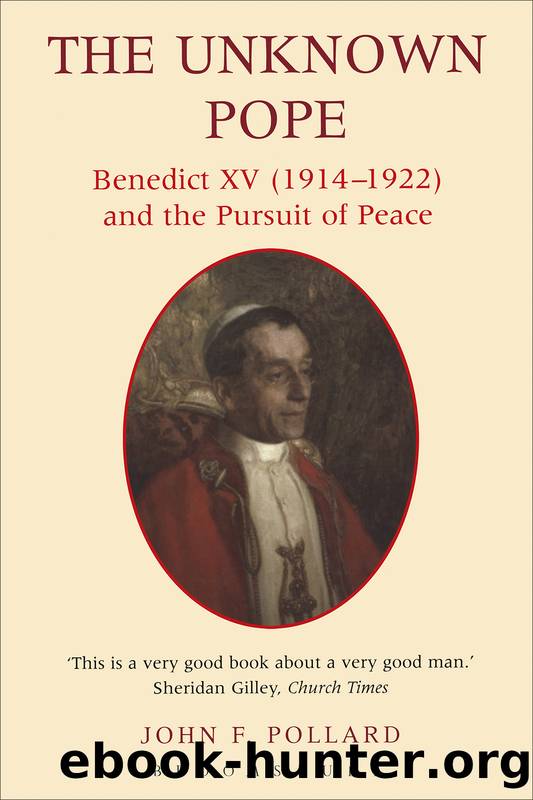
Author:John Pollard
Language: eng
Format: epub
Publisher: Bloomsbury Publishing
Published: 1999-11-14T16:00:00+00:00
Papal peace diplomacy
The publication of the Apostolic Exhortation, âTo the Belligerent Peoples, and their Rulersâ, of 28 July 1915, marks a turning point in the development of Vatican policy during the course of the war; it was at this stage that Benedict and Gasparri committed themselves to active diplomacy in the cause of peace: âa peace offensiveâ that would culminate in the famous âPeace Noteâ of August 1917.30 Their decision to do so at this point was determined by two factors: Italyâs entry into the war was, as has been seen, causing serious problems for the Holy See, and the fact that it was clear the belligerent powers were unable or unwilling to initiate peace moves themselves.
The Exhortation, written to commemorate the first anniversary of the outbreak of the war, contained an apocalyptic warning of the dangers of not seeking a negotiated peace: âAbandon the mutual threat of destruction. Remember, Nations do not die; humiliated and oppressed, they bear the weight of the yoke imposed upon them, preparing themselves for their come-back and transmitting from one generation to the next a sad legacy of hatred and vendetta.â31 The phrase âNations do not dieâ was one of Benedictâs most evocative and memorable, and was followed by a very explicit invitation to the belligerents to go to the negotiating table:
It is not true that this conflict cannot be resolved without the violence of arms ⦠Why not from this moment consider with a serene conscience the rights and just aspirations of peoples? Why not commence in good will an exchange, direct or indirect, of views with the purpose of keeping in mind as far as possible those rights and those aspirations and thus put an end to this conflict, as has happened in other circumstances? Blessed be he who first raises the olive branch of peace and extends his right hand to the enemy offering reasonable conditions for peace. The equilibrium of the world and prosperity and secure tranquillity of nations rest on mutual benevolence and the respect of the rights of and dignity of others, rather than on a multitude of armies and a formidable ring of fortresses.32
The reference to an âindirectâ as well as direct exchange of views was clearly intended as a hint that the Holy See would be willing to assist in the making of secret contacts.
In fact, Benedict and Gasparri had already actively engaged in a quite sustained peace âoffensiveâ, that is they had striven to preserve the peace between Italy and Austria-Hungary throughout the whole period of the formerâs neutrality, August 1914 to May 1915. After the failure of that episode in Vatican diplomacy, some prompting to resume their efforts and extend their scope must have come from the awareness that the Pope was increasingly being seen by a variety of groups as a major force for peace. In May 1915 the Pope received a delegation from the Dutch Roman Catholic State Party to discuss the possibility of a peace conference at The Hague.33 A month
Download
This site does not store any files on its server. We only index and link to content provided by other sites. Please contact the content providers to delete copyright contents if any and email us, we'll remove relevant links or contents immediately.
Professional Troublemaker by Luvvie Ajayi Jones(29757)
Empire of the Sikhs by Patwant Singh(23200)
Twilight of the Idols With the Antichrist and Ecce Homo by Friedrich Nietzsche(18775)
Plagued by Fire by Paul Hendrickson(17536)
The Sun and Her Flowers by Rupi Kaur(14628)
Norse Mythology by Gaiman Neil(13564)
Fangirl by Rainbow Rowell(9462)
A Journey Through Charms and Defence Against the Dark Arts (Harry Potter: A Journey Throughâ¦) by Pottermore Publishing(9335)
Adultolescence by Gabbie Hanna(9020)
Wonder by R.J. Palacio(8712)
Tools of Titans by Timothy Ferriss(8592)
Becoming Supernatural by Dr. Joe Dispenza(8367)
How to Bang a Billionaire by Alexis Hall(8275)
Wonder by R. J. Palacio(8239)
Crystal Healing for Women by Mariah K. Lyons(8006)
The Road Less Traveled by M. Scott Peck(7730)
The Lost Art of Listening by Michael P. Nichols(7616)
The Witchcraft of Salem Village by Shirley Jackson(7434)
The Institute by Stephen King(7151)
